Plans to Launch Multi-String Inverters in Response to the Diversification of Solar Applications
[Industry News | Reporter Jeong Han-kyo] A warning light has emerged in Korea’s solar industry. As the domestic solar market has rapidly contracted over the past several years, Korea’s solar manufacturing industry is facing a major crisis. The situation is particularly serious in manufacturing, with concerns now extending to the potential collapse of the broader industry ecosystem.
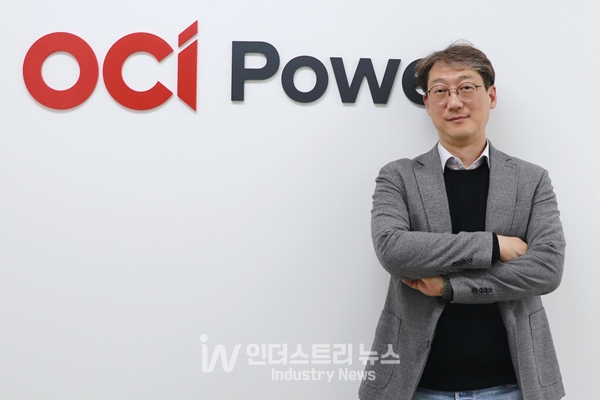 Seong-taek Lim, Head of the Research Center at OCI Power. [Photo: Industry News]
Seong-taek Lim, Head of the Research Center at OCI Power, said: “As numerous companies that had already entered the Korean solar market competed within a limited market, price competition intensified, and Chinese companies with greater price competitiveness aggressively captured market share. Inverter companies that have supplied high-quality, domestically manufactured products to the Korean solar market have been pushed into a difficult position.”
Despite these challenges, OCI Power has maintained its position as a company representing the pride of Korea’s domestic solar inverter industry. Even as competition has become difficult enough for some Korean inverter manufacturers to consider withdrawing from the business, OCI Power has continued investing in product supply and new product development.
Lim said: “Because grid connections were not sufficiently prepared, permitting for the large-scale solar power plants that represent OCI Power’s primary market continued to be delayed, resulting in weak new large-scale sales. Nevertheless, we achieved approximately 25% sales growth compared with 2023 by actively entering new markets such as replacement projects for aging inverters and ESS and fuel cells that can complement solar power, expanding revenue through business development and EPC, and directly responding to the aftermarket for domestic and overseas inverters.”
OCI Power’s continued commitment to solar inverter manufacturing despite difficult market conditions reflects its belief that “without a domestic manufacturing industry, there can be no energy security.” With this conviction, the company is also taking on new challenges.
OCI Power has long been regarded as synonymous with central inverters. Even as market attention shifted toward string inverters, OCI Power continued to supply central inverters with a consistent commitment.
However, to broaden customers’ options and respond to increasingly diverse solar applications, the company plans to launch multi-string inverters. This does not mean that it is reducing its focus on central inverters. Last year, OCI Power launched an ultra-high-efficiency central inverter with a maximum efficiency of 99.4%.
Lim said: “String inverters are expected to undergo KS certification soon. Since last year, KEPCO has revised its regulations for the use of transmission and distribution electrical equipment, requiring grid analysis. We have therefore completed the development of simulation models for our key products. OCI Power will continue to provide inverter technologies optimized for Korea’s grid operations.”
What products will OCI Power focus on in the Korean solar market in 2025?
The ultra-high-efficiency central inverter launched last year achieves a maximum efficiency of 99.4%. Each unit has a capacity of 1.1 MW and can be expanded to up to 4.4 MW using a modular configuration.
Controlling the internal temperature of an inverter is technically very important. This product improves heat dissipation in the power conversion section by optimizing its internal structure compared with previous models.
Installation convenience was also considered from the design stage, allowing the output busbar to be connected from either the left or right side of the product.
What does 99.4% efficiency mean?
OCI Power is believed to be among the first companies to achieve 99.4% inverter efficiency using an air-cooled system.
Efficiency is directly linked to the profitability of a power plant. Even if our product costs approximately 7% more to install than a product from a particular Chinese company, increasing generation efficiency by just 1% could allow the additional cost to be recovered within two to three years.
Recently, some large-scale solar power plants have also begun installing string inverters instead of central inverters.
Previously, the dividing line between string and central inverters was generally around the 100 kW class. This gradually increased to 125 kW and 250 kW, and the introduction of 350 kW multi-string inverters is now becoming a reality.
OCI Power is also preparing to launch a multi-string inverter.
Does this mean the role of central inverters is declining?
No.
Suppose a 30 MW solar power plant is built using 350 kW string inverters. Approximately 100 units would need to be installed.
The advantage of string inverters is that if one unit fails, only approximately one-hundredth of the plant’s generation capacity is affected.
But what is the disadvantage? Maintaining 100 inverters is not easy either.
At even larger plants, such as 100 MW facilities, even more inverters would need to be installed. The volume of data also increases, making network-based O&M more difficult. This inevitably raises questions about whether installing hundreds of small inverters at a single site is the most efficient approach.
What are the strengths of inverters manufactured by Korean companies?
It is true that the performance of Chinese-made inverters has become much more stable. Their claim that they offer both competitive prices and performance has gained credibility.
However, solar inverters are power generation equipment designed to be used for at least 10 years and often longer. Price is certainly important, but I believe products should also be selected based on a long-term perspective on operating a power plant five or ten years into the future.
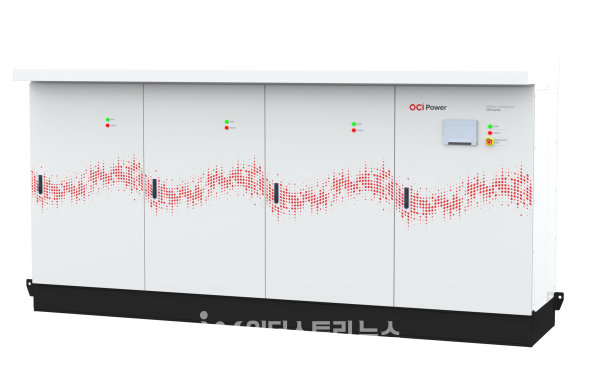 OCI Power’s ultra-high-efficiency central inverter, the OG Series. [Photo: OCI Power]
A solar inverter is a piece of power generation equipment that can cause significant losses, including a blackout at a power plant, if it fails.
Failures and generation losses can result not only from insufficient inverter technology or quality but also from external factors such as grid abnormalities, which account for a 33% generation loss rate, and switchgear, which accounts for a 35% generation loss rate.
However, it is very difficult to clearly identify the causes of these generation losses. Therefore, it is important to select not only a reliable inverter product but also a company that can provide maintenance guidelines and continuously monitor and manage the equipment.
OCI Power provides technical services that allow customers to verify the compatibility between inverters and the grid in advance through the development of inverter models capable of grid analysis and simulation.
We have also secured KEPCO’s smart inverter functions, including VRT and FRT, to improve grid stability and system operability.
What is OCI Power’s response strategy, including A/S?
Our own field engineers directly respond to all sites nationwide.
For large-scale solar power plants, we provide technical support through regular inverter management programs during installation, commissioning under energized conditions, pre-use inspection, and after commercial power generation begins.
We also operate Gunsan, Jeonbuk, where our manufacturing plant is located, as a customer service hub to strengthen services in the Honam region, where many solar power plants are located.
At the hub, major components are stored in a specialized warehouse with controlled environmental conditions, enabling us to provide rapid and high-quality service.
This year, we are also focusing on preventive measures and inspection recommendations to prevent the problems caused by concentrated customer service demand following abnormal weather conditions last year and to support stable plant operations and improved profitability.
What are OCI Power’s future plans and goals?
OCI Power is a solar inverter manufacturer whose strengths lie in technology and service.
We plan to continue our business despite rapidly changing domestic and international conditions and actively expand into overseas markets based on the reliability we have established in Korea’s solar market.
As we have done so far, we will continue preparing for the future through proactive product development and strive to become a company capable of growing by 20% every year.
Source :
인더스트리뉴스 (IndustryNews)


 List
List