OCI Power and Enerdot Jointly Develop Real-Time Automatic Control Technology Without Interrupting Power Generation
Software-Based Control Overcomes the Limitations of Physical Shutdowns, Improving Grid Stability and Reducing Operational Losses
97% Output Tracking Verified and Platform Integration Commercialized, Expanding Service Competitiveness
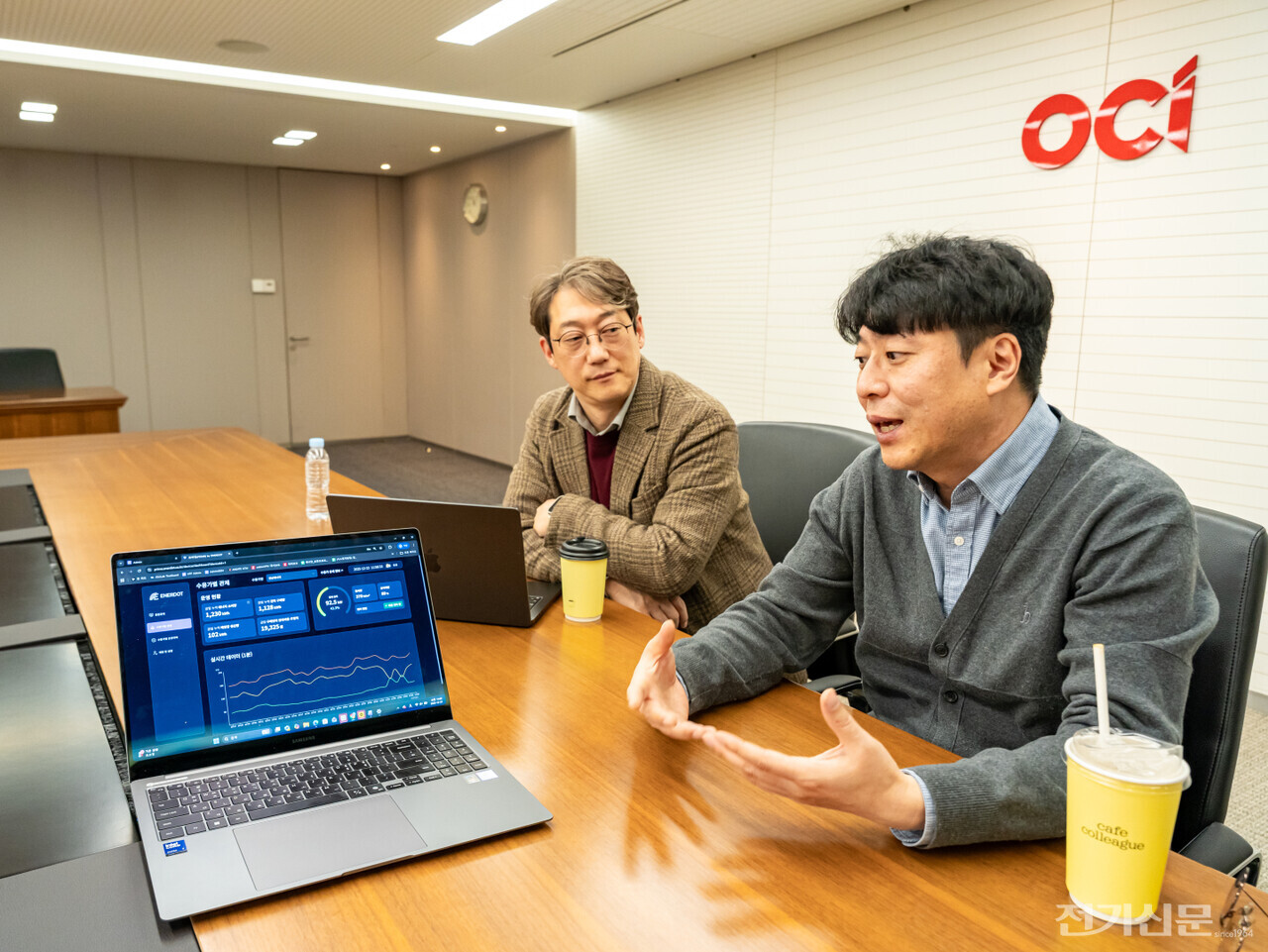
▲ Lim Seong-taek, Head of OCI Power’s Research Institute (left), and Jang Jin-wook, Head of Enerdot’s Research Institute (right), explain the demonstration results of the reverse power flow control solution. [Photo: Jin-hoo Kim]
A technology that addresses the issue of reverse power flow from solar power systems through control rather than shutdown has been demonstrated for the first time in Korea. Unlike conventional output curtailment methods, which shut down equipment when reverse power flow is detected, the new approach keeps the solar power system operating while precisely adjusting its output. By addressing the seemingly conflicting objectives of grid stability and energy utilization simultaneously, the technology is expected to reduce operational losses and inefficiencies while opening new possibilities for the wider adoption of self-consumption solar power.
In a recent interview with The Electrical Times, Lim Seong-taek, Head of OCI Power’s Research Institute, and Jang Jin-wook, Head of Enerdot’s Research Institute, explained the background behind the technology.
“As self-consumption solar systems become more widespread, there are clear limitations to addressing reverse power flow solely through physical shutdowns.”
The reverse power flow control technology jointly developed by the two companies is a prediction-based solution that automatically adjusts inverter output in real time to prevent reverse power flow from occurring in self-consumption solar systems.
The system uses the actual electricity consumption of factories and buildings as a reference and controls solar output so that it does not exceed on-site demand. By responding through software before reverse power flow occurs, the system can maintain power generation rather than shutting down the equipment. The key feature is its ability to adjust output only to the minimum level required.
The technology was demonstrated last year at a 215 kW self-consumption solar installation in Korea. It was the first case in the Korean solar market in which a reverse power flow control solution was deployed and operated at an actual site. The demonstration achieved output tracking of approximately 96–97% relative to electricity consumption, while solar power accounted for 29% of total daily electricity consumption.
Because self-consumption solar systems are contracted on the assumption that electricity will not be exported to the grid, excess electricity flowing into the distribution network can result in contract violations and penalties. Unexpected reverse power flow can also cause protection relay malfunctions and equipment damage, and in severe cases may increase the risk of grid instability or power outages. This issue is particularly relevant to factories, where electricity consumption can differ significantly between weekdays and weekends. During holidays, electricity consumption can drop sharply while solar generation continues, increasing the possibility of reverse power flow.
The problem is that conventional solutions have largely relied on shutdowns. When reverse power flow is detected, a circuit breaker trips in response to a protection relay signal, immediately stopping the system. While this approach ensures grid safety, system recovery depends entirely on manual intervention. If a physical trip occurs over a weekend or holiday and is not detected immediately, the equipment may remain offline for an extended period, resulting in accumulated generation losses.
Lim Seong-taek, Head of OCI Power’s Research Institute, explained: “The limitation of conventional reverse power flow prevention is not a technological problem but an operational one. Although grid safety can be secured, losses continue to occur because subsequent operation depends on manual intervention.”
The newly developed technology addresses this issue through automatic control. It collects and processes electricity consumption and generation data in real time and adjusts the output of multiple inverters either simultaneously or individually.
Jang Jin-wook, Head of Enerdot’s Research Institute, said: “The key is to make the output follow electricity consumption instead of shutting down the power generation system. Predictive control is applied to prevent reverse power flow even when loads change rapidly.”
Control is performed at the site level. A Remote Terminal Unit (RTU) collects and analyzes data at one-second intervals and also executes control commands. This means that the reverse power flow prevention function remains operational even if a communication failure occurs. Once communication is restored, control history and data are automatically reflected on the platform. Existing reverse power relays and circuit breakers based on conventional protection standards remain in place as the final layer of safety protection.
The system also features an algorithm capable of simultaneously or individually adjusting the output of multiple inverters, providing advantages in terms of versatility and grid responsiveness
This technological shift could also affect the role of self-consumption solar in the energy market. Self-consumption solar systems have traditionally been viewed as a means of supplementing on-site electricity consumption without interacting with the grid. However, with precise control and data-driven operation, they could evolve into energy management assets. As industrial electricity prices remain higher than SMP and REC prices in certain market conditions, self-consumption solar is becoming more than a cost-saving measure—it is increasingly becoming part of corporate energy strategies. For companies operating self-consumption solar systems, the resulting data can also serve as a basis for internal reporting and investment decisions.
With further regulatory development, self-consumption facilities could potentially evolve into prosumers that trade surplus electricity. The technology could also serve as a foundation for the expansion of VPPs (Virtual Power Plants) and EMS (Energy Management Systems).
Jang Jin-wook explained: “Until now, self-consumption solar systems have lacked effective ways to systematically demonstrate how much electricity and cost they have actually saved. Through our platform, we plan to visualize and provide data on the share of solar power in total electricity consumption, cost savings before and after installation, and self-consumption performance by time of day.”
The two companies are also developing a joint sales strategy. The plan is to equip inverters with basic control functions while maximizing the value of the solution through platform integration. OCI Power will contribute its equipment competitiveness, while Enerdot will provide its predictive control and platform capabilities. Together, the companies aim to address the self-consumption solar market as well as emerging centralized energy management systems.
Distributing power generation across different time periods through output control could also help reduce grid congestion and expand the capacity for renewable energy interconnection.
Lim Seong-taek added: “Self-consumption solar has now moved beyond simply asking how much capacity can be installed. The focus is shifting toward how reliably existing systems can be operated. When output control based on actual consumption becomes established, self-consumption solar can evolve beyond a simple cost-saving measure into a sustainable energy management model.”
Source : 전기신문 (Electimes)


 List
List