OCI Power CEO Kim Seong-yeop: “The Chinese Dominance of Solar Inverters Makes Localization a Matter of Survival”
Posted date2025. 12. 26
Views780
Copy link
Chinese Companies Have Effectively Taken Over Korea’s Solar Value Chain
Mandatory Use of Korean-Made Products in Public Procurement Is Essential
OCI Power Develops and Manufactures Large-Scale Central Inverters In-House
Expanding BIPV Supply for Distributed Renewable Energy and Urban Applications
“Chinese solar inverter companies entering the Korean market are not here simply to make money in the short term. They are entering the market to clear excess inventory produced in China by aggressively lowering prices and triggering a price war in Korea. If Korean companies eventually withdraw from the market due to chronic losses and a monopoly structure is established, there may be little the Korean government can do when replacement prices are subsequently raised.”
Kim Seong-yeop, CEO of OCI Power, issued this warning in an interview with Edaily held at OCI Building in Jung-gu, Seoul, on the 23rd. He warned that unless effective measures, such as mandatory use of domestically manufactured components, are implemented in a timely manner, not only small and medium-sized component manufacturers but also the remaining Korean solar companies could face difficulties surviving. “If the current trend continues, we could lose not only the possibility of developing ‘sovereign inverters’ but the entire solar value chain to China.”
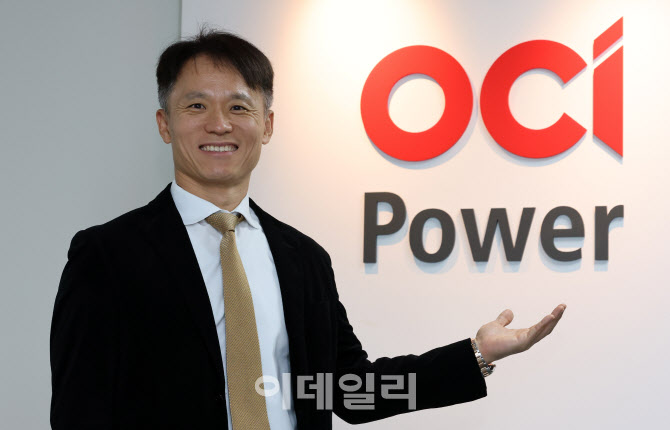
▲ Kim Seong-yeop, CEO of OCI Power, during an interview with Edaily on the 23rd. [Photo: In-kwon Bang, Edaily]
Developing Central Inverters In-House to Compete with Chinese Products
The Korean government has recently taken measures in response to growing concerns that the domestic solar ecosystem is being undermined by Chinese products. To prevent cases in which Chinese-made inverters are relabeled and presented as domestic products using Korean components, the government plans to provide additional points in public procurement when products have a high proportion of domestically manufactured components. However, some industry observers argue that such measures remain insufficient because they are largely advisory in nature and because the domestic solar ecosystem has already lost competitiveness in areas such as technology and pricing.
Kim said: “It is extremely difficult for Korean manufacturers to compete with Chinese inverter prices, which benefit from economies of scale, lower labor costs, and low production prices, even if we manufacture in Southeast Asia. Although the government has finally begun preparing measures, it needs to implement effective policies that would make the use of Korean-made inverters mandatory, at least for public projects, while significantly expanding support.”
The solar power industry spans the value chain from polysilicon → ingot → wafer → cell → module → inverter. After domestic supply chains for wafers, cells, and modules were weakened by low-cost Chinese products, Chinese manufacturers have also come to account for an estimated 90% of the domestic solar inverter market. Against this backdrop, OCI Power is focusing on the development and in-house manufacturing of central inverters, rather than the small-scale string inverters that Chinese manufacturers primarily focus on.
Kim explained: “Our central inverters meet grid interconnection standards tailored to the characteristics of the Korean power system. We also have advantages in rapid technological response through our domestic R&D and manufacturing resources, as well as maintenance through our domestic service personnel. We are doing our best to secure a competitive advantage in the inverter market by working together with small and medium-sized companies with which we have mutually beneficial relationships.”
Regarding security concerns surrounding Chinese-made inverters, including potential backdoors and overseas transmission of data, Kim emphasized the need for stronger security measures.
“Data showing domestic power generation patterns could potentially be transmitted to remote servers, or communications could be carried out without clearly identifying the manufacturer or operator. This could pose a serious threat to domestic power grid management. While it is important for individual companies to strengthen their internal security architectures, the government also needs to establish a system requiring rigorous security certification.”
U.S. Sales Expected Next Year, with Solutions Linked to Edge Data Centers
OCI Power plans to expand beyond the Korean market and accelerate its entry into the U.S. market next year. In the central inverter business, the company is preparing maintenance services for large-scale solar projects it carried out in the United States more than a decade ago, while also preparing to launch new products for the U.S. market in the second half of the year.
Kim said: “When we carried out a solar power project in Texas in the early 2010s, we installed approximately 1 GW of central inverter capacity. Those projects are now reaching the maintenance stage, creating sales opportunities. Once we obtain certification from Underwriters Laboratories (UL) in the United States next year, we expect sales of new products for the U.S. market to begin in earnest in the second half of the year.”
Since introducing Korea’s first central solar inverter to the market in 2012, OCI Power has continued to develop technologies and business capabilities in key power conversion equipment, including central inverters, PCS, and PowerStack, making it one of the few Korean companies maintaining a presence across these areas. The company also plans to actively pursue new businesses that could become future growth drivers.
Kim said: “We see opportunities in renewable energy generation linked to edge data centers, a distributed renewable energy model in which electricity is generated, stored, and controlled near data centers rather than through centralized power generation. We are preparing integrated solutions for this market.



 List
List