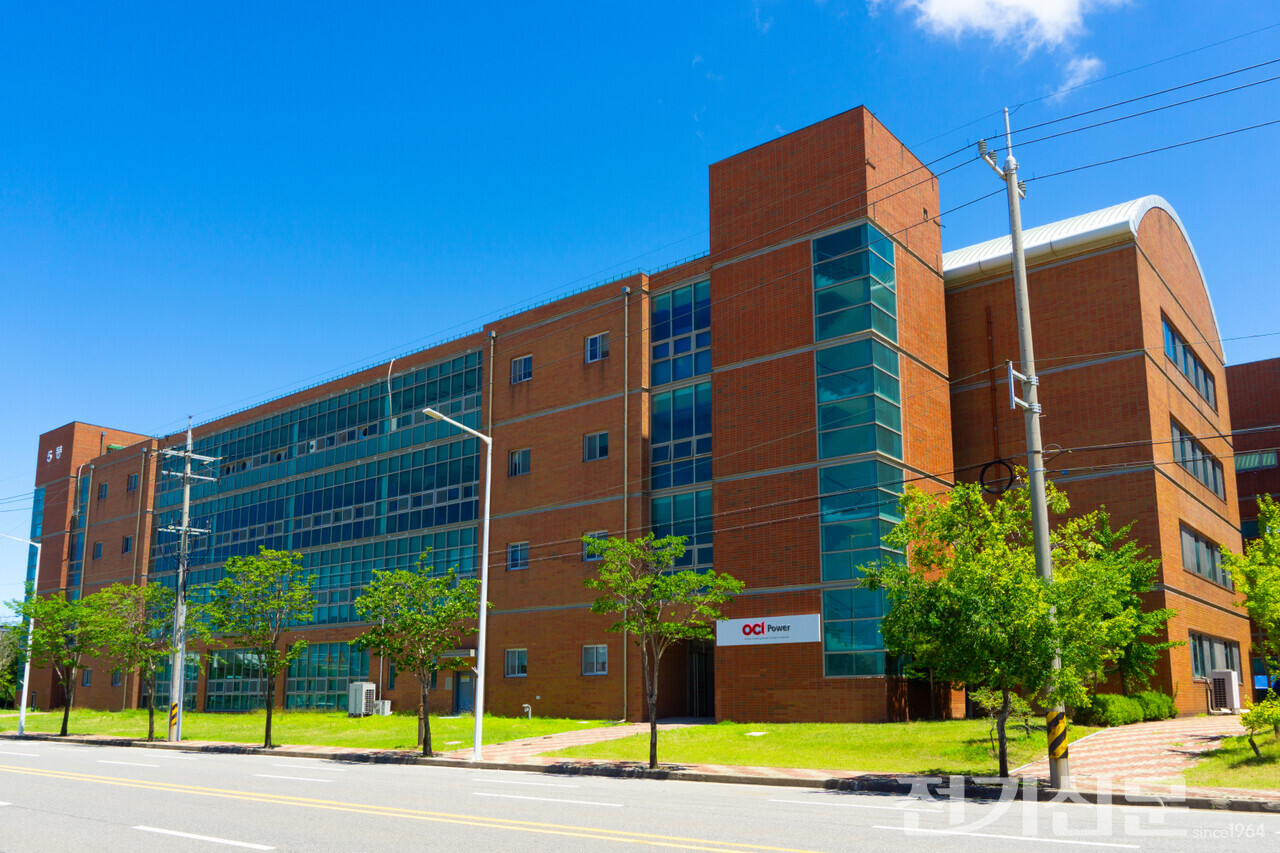
 Exterior view of OCI Power’s Gunsan plant,
located in the Saemangeum Free Trade Zone in Gunsan, Jeollabuk-do. [Courtesy of OCI Power]
OCI Power’s manufacturing base is located in the Saemangeum Free Trade Zone in Gunsan, Jeollabuk-do. While the Saemangeum Industrial Complex has experienced its share of difficulties, including plant shutdowns and business withdrawals, the atmosphere inside OCI Power’s facility is markedly different.
On the first floor, large-scale inverters scheduled for delivery to the Imha Dam floating solar power project are being assembled and prepared for shipment. On the second floor, quality inspections are in full swing. Skilled employees working across each production process are noticeably busy.
At this plant, which holds approximately 60% of Korea’s large-scale solar inverter market, the competitiveness of Korea’s renewable energy industry is being put to the test.
◆“The Only Korean Company Providing Integrated Inverter Manufacturing and After-Sales Service”
OCI Power is one of Korea’s leading companies specializing in the development and manufacturing of central inverters for solar power generation and power conversion systems (PCS) for energy storage systems (ESS).
Since its establishment in 2007, the Gunsan plant has produced approximately 270 MW annually—equivalent to around 360 units based on the OP750 model—and has secured production capacity of up to 1 GW.
The plant manufactures a diverse portfolio of products, including small-capacity string inverters, large-scale central inverters, and combiner boxes. It was also at the Gunsan plant that OCI Power developed and supplied Korea’s first 1,500 V DC inverter in 2020.
One of the plant’s greatest strengths is its ability to manage the entire process in-house, from design and manufacturing to quality inspection and after-sales service. Digital transformation has been introduced into key production processes to improve efficiency, while skilled technicians remain directly involved in wiring, assembly, and inspection to ensure product quality. The production and assembly process alone consists of six stages, followed by multiple layers of quality inspection to enhance product completeness and reliability.
Chang-soo Lee, head of the Gunsan plant, said: “OCI Power is the only company in Korea that designs and manufactures inverters domestically while also directly providing after-sales service. We are maximizing productivity through advanced technology, automation, and rigorous quality control.”
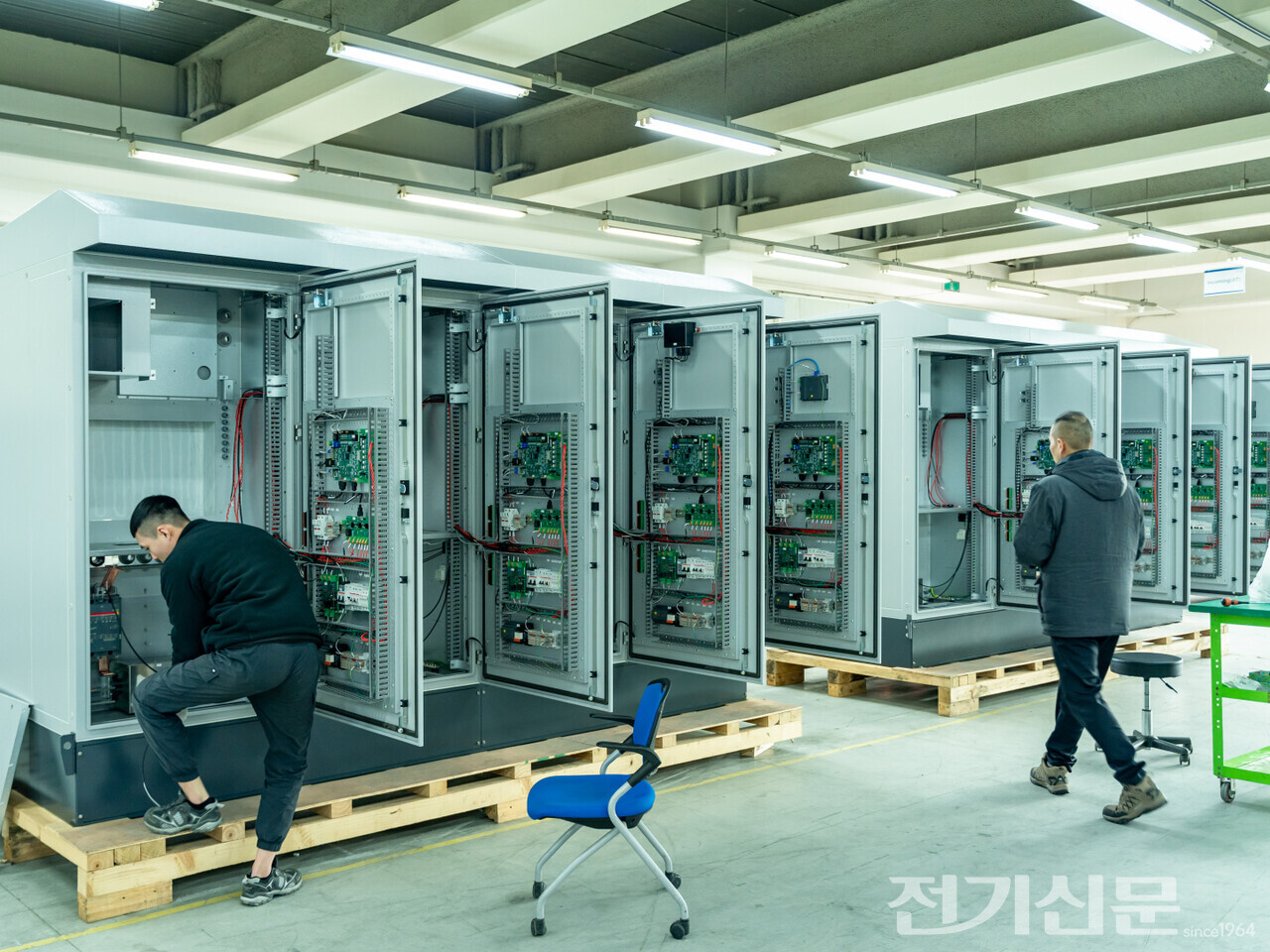 Employees at OCI Power’s Gunsan plant manufacture large-scale inverters scheduled for shipment
to the Imha Dam floating solar project. [Photo by Jin-hoo Kim]
The inverter manufacturing process observed at the plant was a continuous sequence of meticulous inspection and verification. The first stage of production is incoming component inspection. Once components are delivered via a large freight elevator, employees conduct quality checks to ensure that each component complies with design specifications. Power semiconductors and printed circuit boards (PCBs), in particular, undergo separate verification procedures because they directly affect product performance. OCI Power explains that these additional processes help minimize defect rates.
The products then proceed through assembly, power-up, and functional testing. One of OCI Power’s key differentiators is its 100% full-load testing process. Inside the plant, a 3 MW test bed is used to conduct real-time quality inspections covering voltage, current, thermal characteristics, power output, and DC load. Only products that meet optimal performance requirements are approved for shipment. OCI Power applies designated load conditions to its 250 kW, 500 kW, and 750 kW inverter models to verify both output performance and durability.
An OCI Power official said: “This is not simply an assembly plant. It is a manufacturing facility equipped with a system that manages every stage of the product lifecycle. To shorten production lead times while maintaining quality, we apply big-data-based quality management systems and real-time monitoring throughout the entire process.”
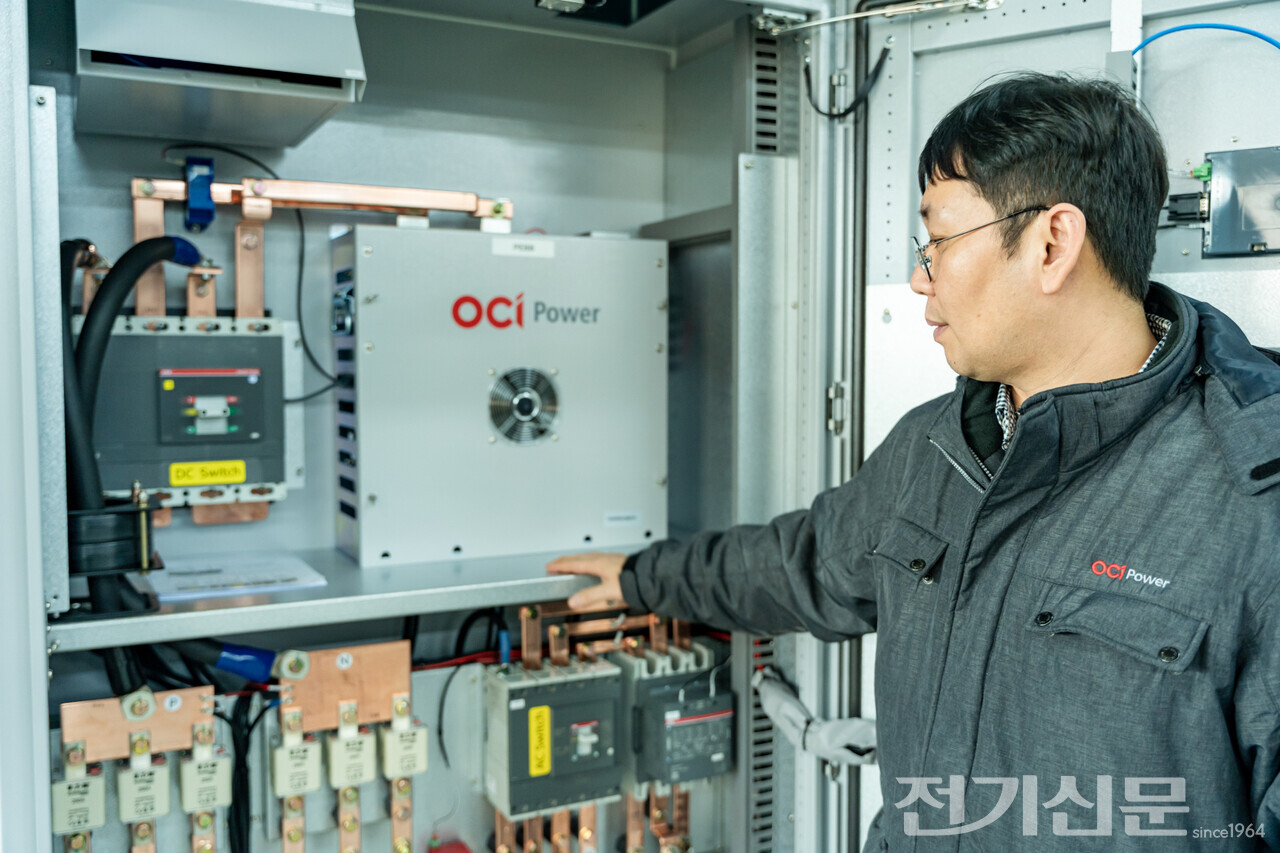 Chang-soo Lee, head of OCI Power’s Gunsan plant, explains the internal structure of an inverter. [Photo by Jin-hoo Kim]
Another reason OCI Power has established a strong position in the large-scale inverter market, with products ranging from 250 kW to 4.4 MW, is its after-sales and maintenance capability.
Lee said: “Maintenance is critical for large-scale inverters. Unlike competitors that outsource service work, OCI Power is the only Korean inverter manufacturer that directly operates its own maintenance workforce. We have personnel deployed across major regions nationwide, enabling us to respond quickly to service requests.”
The Gunsan plant is not only a manufacturing base but also a hub for product advancement. One representative example is OCI Power’s effort to localize semiconductors and power conversion components, which account for a significant portion of inverter production costs. The company continues to conduct research and development with partner companies to increase the proportion of domestically sourced components.
Lee said: “During the COVID-19 pandemic, we experienced severe difficulties in securing components and realized how risky excessive dependence on overseas suppliers could be. We are now developing our products with the goal of expanding the use of domestically produced components.”
OCI Power currently holds approximately 60% of Korea’s large-scale inverter market and has accumulated more than 3 GW of installations in Korea and overseas. Industry observers attribute this position to the company’s technological capabilities and quality management. OCI Power plans to continue investing in production facilities and R&D to strengthen its competitiveness in global markets. As part of this strategy, the company is diversifying its product portfolio and plans to develop, manufacture, and commercialize a 130 kW-class string inverter for the first time.
Lee added: “Based on these capabilities, OCI Power’s inverters have obtained not only Korea’s KS certification but also UL certification in the United States and CE certification in Europe. We are steadily preparing for expansion into global markets. We have also recently entered the U.S. 1.1 MW inverter market and expect to generate meaningful results in North America.”
He also emphasized that consistent renewable energy policies will be necessary to support continued growth and technological advancement.
“Our immediate goal is to strengthen our technological capabilities by expanding the test bed. At the same time, we hope that a stable renewable energy expansion policy will be established so that companies can make long-term investment decisions with confidence.”
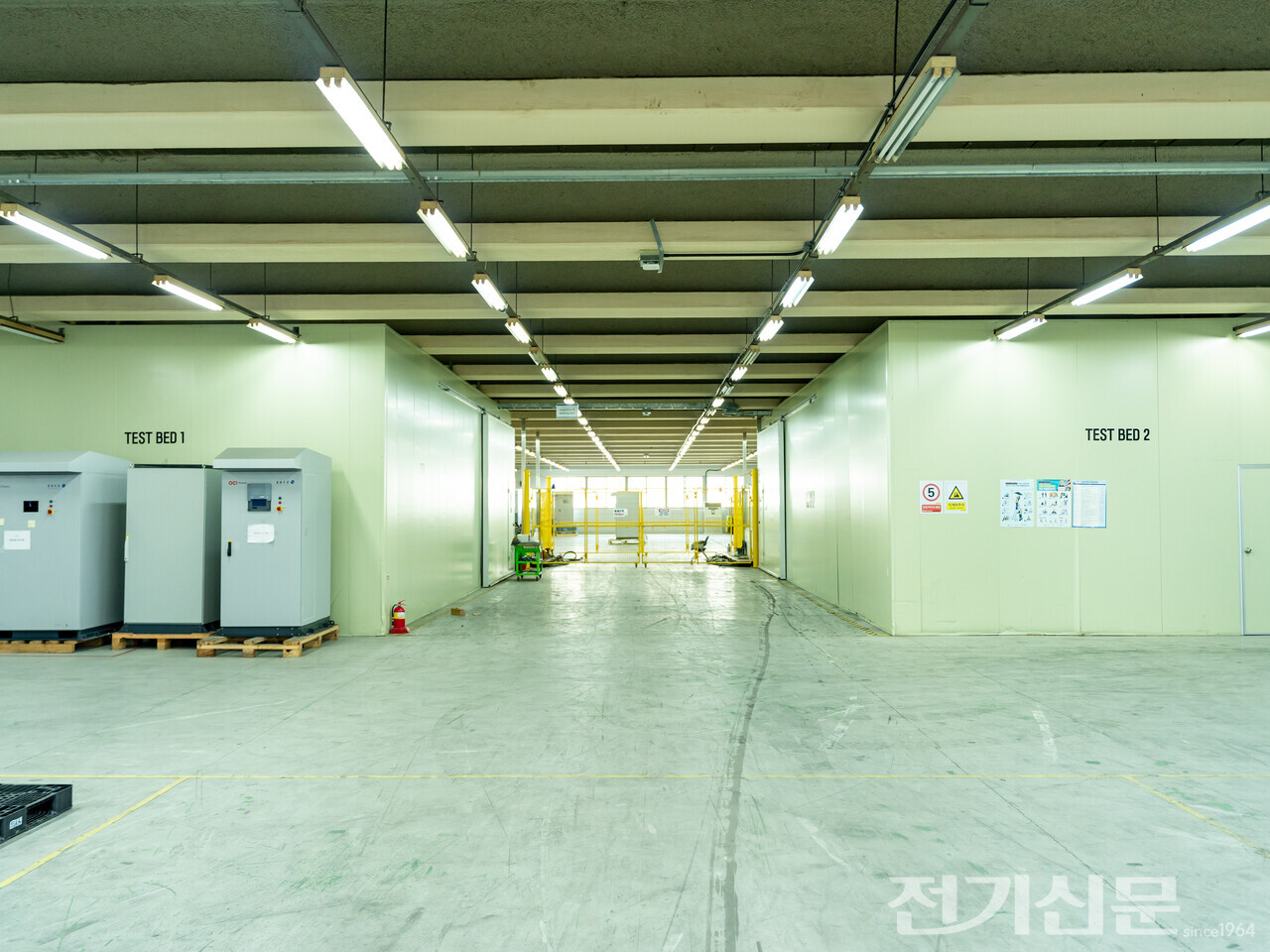 OCI Power’s 3 MW test bed. [Photo by Jin-hoo Kim]
Source :
전기신문 (Electimes)


 List
List