[Industry News | Reporter Jeong Han-kyo] Following last year’s gathering, CEOs of leading domestic and international solar PV and ESS (Energy Storage System) companies came together once again. After strengthening industry collaboration through their first meeting last year, this year’s event provided an opportunity to share strategies for “reorganization, transformation, and growth” in the rapidly changing energy market and reaffirm their commitment to mutual growth.
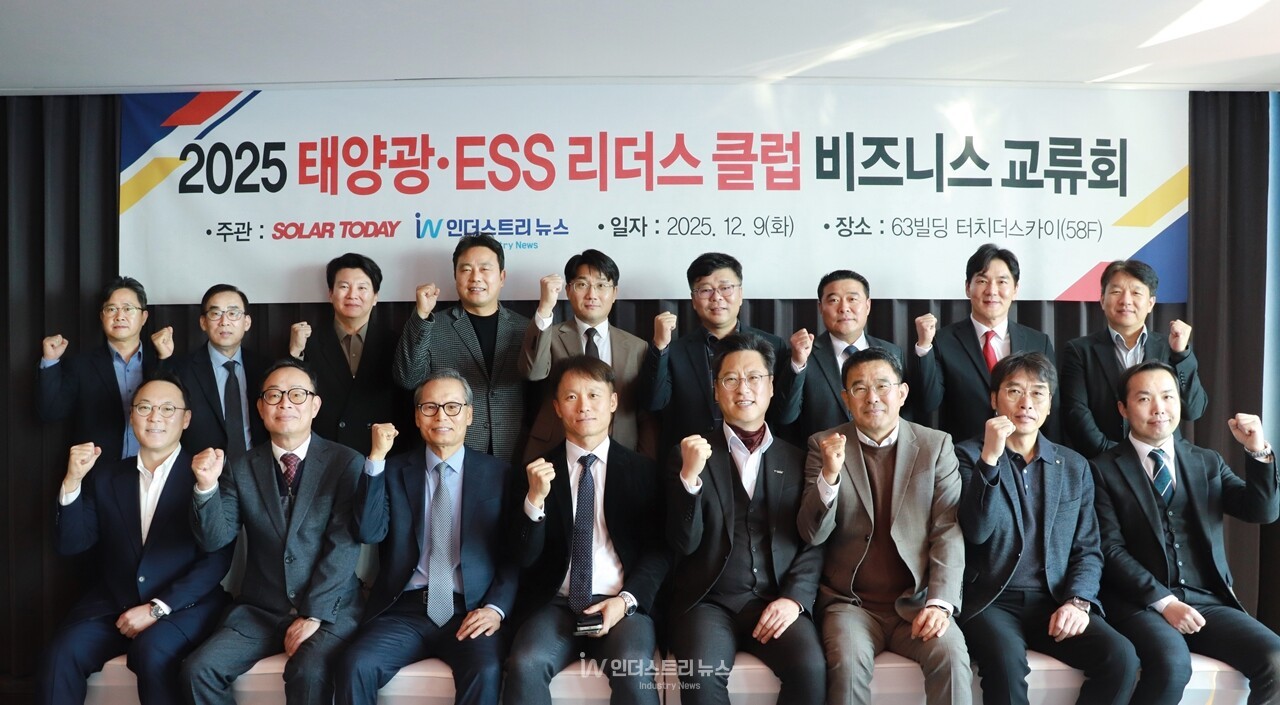 Participants of the 2025 PV & ESS Leaders Club Business Exchange pose for a commemorative photo. [Photo: Industry News]
Since January 2024, Solar Today and Industry News have been conducting a monthly relay interview series featuring CEOs of leading Korean companies contributing to carbon neutrality and digital transformation and leading their respective industries under the theme “Change The World.”
Now in its second year, the PV & ESS Leaders Club Business Exchange selected a total of 24 CEOs of major solar PV and ESS companies, beginning with Jong-hwan Park, CEO of HD Hyundai Energy Solutions, in January 2024 and concluding with Nan-gu Wi, CEO of Grand Sun Technical Group, in December 2025.
Accordingly, the 2025 PV & ESS Leaders Club Business Exchange, held on the 9th at the 63 Building in Yeouido, Seoul, was attended by CEOs who had participated in the 2024 interview series, including Ahn Byung-jun, CEO of Solarplay (August); Lee Sang-gon, CEO of BME (September); Kang Tae-young, CEO of BA Energy (October); Kim Hee-sung, Chairman of Bright Energy Partners (BEP) (November); and Shin Dae-hyun, CEO of Daeyeon C&I (December).
The event was also attended by leaders featured in the 2025 interview series, including Jeong Chang-kwon, CEO of Incell (January); Kim Jung-sik, CEO of Sollab (February); Kim Ho-seop, Country Manager of Sungrow Power Korea (March); Lee Jae-myung, CEO of Daegun Soft (April); Han Min, CEO of EtaSolar (May); Chin Yuan, Head of the Digital Power Business Division at Huawei Korea (August); Kim Seong-yeop, CEO of OCI Power (September); Jeong Seong-won, CEO of SDN (October); and Lee Jin-seop, CEO of SG Energy (November).
Park Jong-hwan, CEO of HD Hyundai Energy Solutions (January 2024); Lee Ji-sun, CEO of Shinsung E&G (February 2024); Ahn Ji-young, CEO of Soul Energy (April 2024); Kim Seong-kwon, CEO of SPV (May 2024); Kwon Oh-hyun, CEO of Haezum (June 2024); Keum Man-hee, CEO of Dasstech (July 2024); Yoo Jae-yeol, Executive Vice President of Hanwha Solutions Qcells Division (June 2025); Lee Young-ho, CEO of Enelton (July 2025); and Wi Nan-gu, CEO of Grand Sun Technical Group (December 2025) were unable to attend due to personal circumstances.
Recently, the Korean renewable energy market has been focusing on emerging issues such as discussions on opening the electricity market, reforms to the ESS system, and the expansion of AI-based energy management solutions such as VPPs and EMS. Against this backdrop, participants agreed that the industry needs to join forces and develop strategies to respond to mounting challenges caused by the domestic economic slowdown and changes in global supply chains.
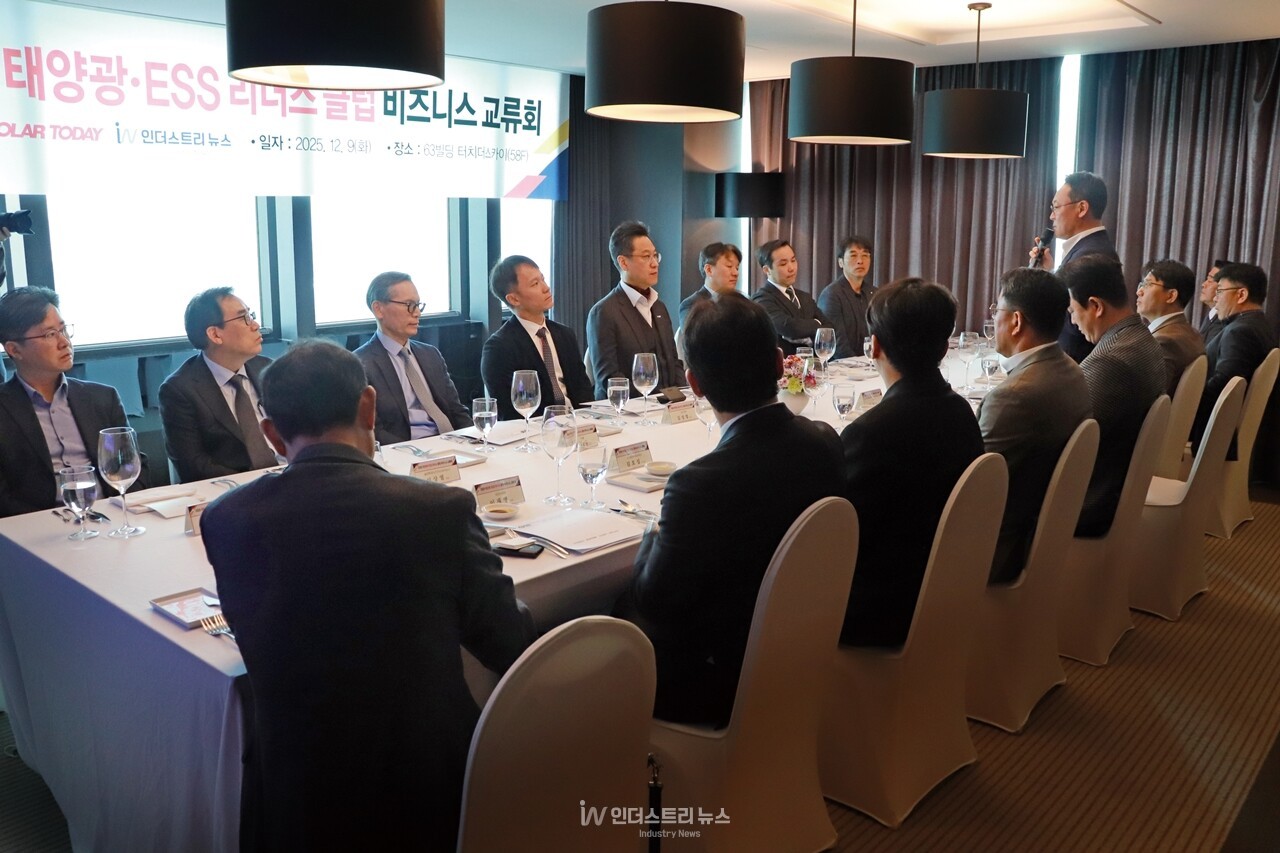 The 2025 PV & ESS Leaders Club Business Exchange was held on the 9th at the 63 Building in Yeouido, Seoul. [Photo: Industry News]
Shin Dae-hyun, CEO of Daeyeon C&I, who was the first to introduce himself, said, “Looking back on this year, I realized that the more difficult things become, the more we have to rely on our employees. Daeyeon C&I, founded in 1998, continues to work hard to keep moving forward. I would appreciate your continued support and advice so that our company can continue to grow.”
Lee Jae-myung, CEO of Daegun Soft, said, “2025 was another difficult year for us, but we intend to move forward with renewed energy as we look ahead to next year. We believe AI-based forecasting solutions will be key to increasing profitability and securing stability in the future, and we are continuing our efforts to expand these solutions across our entire system.”
Kim Ho-seop, Country Manager of Sungrow Power Korea, said, “The year before last was difficult, last year was difficult, and this year has been difficult as well. It always seems to be difficult. Nevertheless, I hope that together with all the CEOs gathered here, we can work toward building a healthy market in Korea.”
Ahn Byung-jun, CEO of Solarplay, said, “Although Solarplay, originally a development and construction company, had planned to transition its business toward operating power generation projects, we decided to move forward once again in order to contribute to the national goal of expanding renewable energy.”
He added, “One of my goals as Chairman of the Korea Solar Energy Association is to increase the number of member companies to 200. I would appreciate your interest and support so that we can speak with a stronger collective voice.”
Kim Jung-sik, CEO of Sollab, said, “The solar industry will remain an important topic as long as humanity continues to exist. Sollab is continuously working to advance technology so that the solar industry can continue to grow sustainably.”
Kim Hee-sung, Chairman of Bright Energy Partners (BEP), said, “There have been many discussions about solar power, but over the past 10 to 20 years, solar has ultimately accounted for a significant portion of renewable energy deployment. Solar is a field that quietly does what it needs to do, and we will continue to contribute to achieving net zero in Korea based on this foundation.”
Kang Tae-young, CEO of BA Energy, said, “This year was the year we achieved our goal of entering overseas markets, which we had set last year. Next year, we intend to expand our customer base across the entire battery value chain.”
Lee Sang-gon, CEO of BME, said, “This year has been one of rapid change both domestically and internationally, particularly in the political sphere. We expect the solar industry to improve positively next year, and BME will also work hard to support this growth.”
Lee Jin-seop, CEO of SG Energy, said, “The BIPV market is growing significantly following the mandatory zero-energy building requirements introduced in 2025. By around 2027, the market could grow to ten times its current size. SG Energy, which currently holds the largest market share, is working to contribute further to the growth of the BIPV market.”
Jeong Seong-won, CEO of SDN, said, “It is an extremely challenging time for domestic module manufacturing. We have experienced ups and downs over the past several years due to competition with imported modules, but inquiries about Korean-made modules have increased again under the current government. I expect domestic modules to gain further momentum next year.”
Chin Yuan, Head of the Digital Power Business Division at Huawei Korea, said, “The Korean solar market is one of the toughest markets. Huawei has opportunities to collaborate not only in solar and ESS, but also in areas such as data centers, AI, and EV charging. We hope to work with many companies to support Korea’s achievement of carbon neutrality.”
Han Min, CEO of EtaSolar, said, “Rapid changes are taking place in new markets such as ESS and BIPV as well as solar. It is becoming increasingly difficult to adapt as the pace of market change accelerates, and I hope companies can collaborate to create new opportunities in these emerging markets.”
Kim Seong-yeop, CEO of OCI Power, said, “The domestic solar market has been very challenging recently. We believe that preparing for the next 20 years is more important than ever, which is why we are expanding our network. The company can grow together only when the ecosystem grows. OCI Power wants to contribute to the growth of the ecosystem.”
Finally, Jeong Chang-kwon, CEO of Incell, said, “The previously stagnant ESS market is beginning to regain momentum. Incell aims to support this growth through immersion-cooled ESS solutions designed with enhanced safety.”
Following last year, Industry News once again met with CEOs of companies leading the renewable energy industry in 2025, providing a platform for collaboration and innovation in a rapidly changing energy market. The PV & ESS Leaders Club, which brings together leaders driving change in the solar and ESS industries, will continue in 2026.
Source :
인더스트리뉴스 (IndustryNews)


 List
List