Interview with Yoo Beom-jun: How Does OCI Power Build Competitiveness in Overseas Markets
Successfully carrying out overseas projects requires more than expertise in a single area. Professionals need to be able to work with numbers while communicating effectively with others. Yoo Beom-jun, Head of the Strategic Sales Division, describes people with these capabilities as “ambidextrous talent.”
His point is that professionals need to go beyond expertise in a single field and develop a broad understanding of other areas in order to remain competitive in global business.
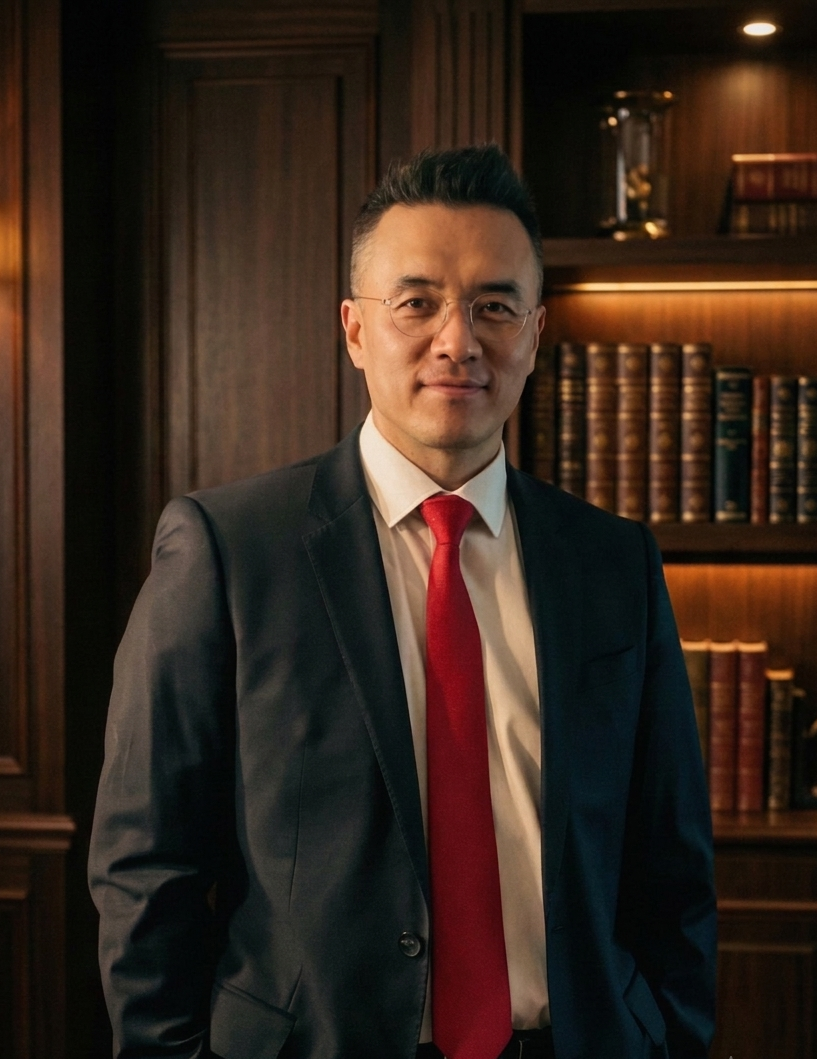
▲ Yoo Beom-jun, Head of the Strategic Sales Division, OCI Power
Another key point Yoo emphasized alongside “ambidextrous talent” is people development. He believes it is important to build an organization where people can learn from one another and grow together. He hopes OCI Power will become a company where employees think, “There are so many great people here. I can grow here, too.”
So, how do OCI Power employees actually develop projects in overseas markets? We spoke with Yoo Beom-jun, Head of the Strategic Sales Division, about everything from how overseas projects get started to the company’s future business direction.
Q. Could you explain how an overseas project typically progresses?
A. Broadly speaking, you can think of it as five stages: opportunity development, project feasibility review, proposal and contract, EPC/installation/commissioning, and O&M.
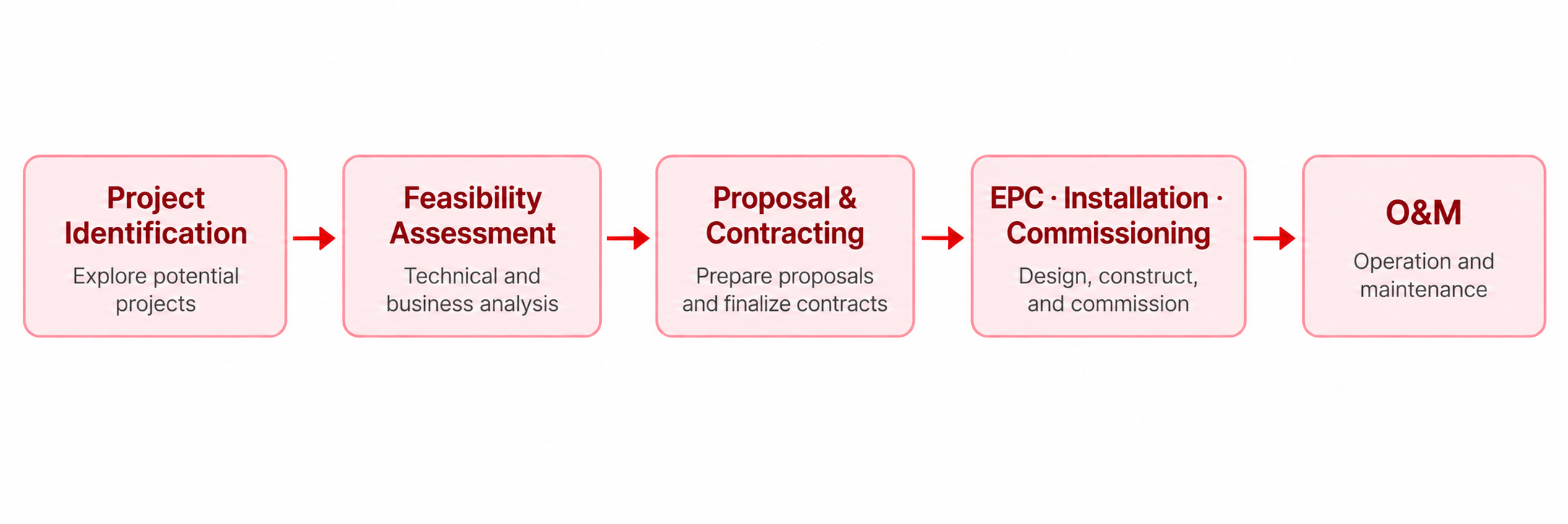
▲ Overseas Project Development Process
When an overseas project begins, the first step is identifying opportunities in the local market. We can identify opportunities ourselves, but we can also leverage the OCI brand. Local buyers or partners may introduce us to opportunities for target solar power plants or ESS projects. That is the first stage.
The second stage is technical review. Specifications and environmental conditions vary from country to country, so we review the specifications of inverters and ESS equipment accordingly. In particular, when carrying out an EPC project, we assess the project’s feasibility by analyzing the expected return on investment.
The third stage is proposing terms such as pricing, delivery schedules, warranties, and local after-sales service conditions, while also reviewing potential risks. Once these conditions are agreed upon, we enter into a contract with the project owner, which may be a government agency or a private developer.
Once the contract is signed, we move on to the fourth stage: EPC. We first conduct engineering and design, then procure equipment based on the design and proceed with construction. We subsequently export our products, install them on site, and handle grid connection and commissioning.
The final stage is O&M. Once a power plant begins operation, equipment issues may occur. We therefore provide maintenance services so that we can respond quickly to equipment failures in the local market.
Q. Do you also directly propose projects?
A. Of course. We also develop and propose projects ourselves.
When government-supported programs or other construction companies in Korea explore overseas opportunities, we identify potential projects. Because we both carry out EPC projects and supply and distribute equipment, we can collaborate with engineering or construction companies to win projects or work with other EPC contractors.
More specifically, we may approach a partner by saying, “There is an opportunity like this in this particular country and region. Would you like to work on it together?” Once we agree on the terms, the partner handles the design, while we provide quotations and supply equipment such as inverters, modules, and ESS, generating sales from the project.
If we undertake the EPC project ourselves, we can generate margins from EPC, equipment supply, and O&M, which creates greater revenue potential but also involves more risk.
By contrast, if we simply distribute equipment, the revenue is generated from the equipment supply, followed by after-sales service, resulting in relatively lower risk.
However, if the total project cost is considered 100, the inverter accounts for less than 10%. The majority consists of land, construction and installation costs, as well as other equipment such as PV modules. When profitability and overall project feasibility are considered, it becomes easier to understand why we pursue EPC projects rather than simply supplying inverters.
Q. Are there specific areas you focus on depending on the country?
A. Since regulations and other conditions differ by country, it is naturally necessary to establish strategies tailored to each market.
The U.S. is a large country with large-scale sites and increasingly high-capacity projects. As a result, a large number of our products have been deployed there, making the U.S. our largest source of sales.
From an industry-trend perspective, the rapid expansion of AI data centers in the United States is driving a tremendous increase in electricity demand and rising electricity prices, particularly in major regions such as Texas. Even under the current administration’s policy direction, renewable energy continues to expand as the country seeks to meet this explosive growth in power demand.
In addition, many projects installed 15 to 20 years ago are approaching the end of their operating lives. As a result, demand for repowering—replacing existing inverters with newer, higher-efficiency equipment—is also increasing significantly.
In Japan, more than 200 units of our 500 kW-class medium- and small-sized inverters supplied since the 2010s have provided a stable foundation for our business.
The Japanese solar market requires high-quality solutions with sophisticated grid interconnection capabilities and suitability for self-consumption systems. Products must also meet strict local standards, including JET certification.
Considering Japan’s mountainous terrain and limited land availability, OCI Power is focusing on rooftop solar, distributed microgrids, and the market for replacing aging inverters. At the same time, we are expanding sales of key components and inverters through collaboration with local O&M partners, further broadening our presence in the market.
The European market also has different characteristics from country to country. However, business opportunities have recently been expanding beyond simple component and standalone equipment sales into the EPC sector. As we continue to receive inquiries from the region, we are strengthening our response while exploring a range of business opportunities.
Q. As you expand your business in the U.S. market, what differentiates OCI Power from global competitors?
A. When entering the U.S. market, technological competitiveness in inverters is a basic requirement, but technology alone is not enough to establish a presence in the market.
The U.S. currently maintains strong trade regulations that effectively restrict the entry of Chinese-made products and equipment containing components from ineligible countries of origin. Even if a product is completed in a designated eligible importing country, delivery may be rejected if it contains components originating from countries such as China. This requires detailed country-of-origin management and the ability to respond effectively to regulatory requirements.
In addition, companies must complete local certification processes that can take at least a year, as well as meet strengthened grid interconnection standards and stringent cybersecurity requirements.
Global Chinese competitors such as Huawei have strong price competitiveness. However, they currently face significant limitations in entering the U.S. market or, even if they enter, in receiving certain U.S. government subsidies or tax benefits. This can ultimately increase the overall cost of a project.
Compared with leading European companies such as Germany’s SMA, OCI Power has a distinct advantage in its close collaboration with its U.S. local entities and affiliated-company network, allowing us to create strong synergies at the group level.
Ultimately, OCI Power provides integrated services based on strong synergies among group companies. By covering the entire process—from business development and the distribution of equipment for solar PV and ESS projects to O&M—we can enhance our ability to respond to regulatory requirements and on-site needs.
Our past experience of directly entering the U.S., establishing a local entity, developing projects, and carrying out EPC projects involved risks. However, it also gives us the ability to reliably deploy the equipment we manufacture and distribute ourselves, such as inverters, at project sites.
Q. Are there any projects you would like to secure now or pursue in the future at OCI Power?
A. Until now, OCI Power has primarily focused on a business model centered on inverter manufacturing and equipment supply to project sites.
However, selling standalone inverters has clear limitations in terms of revenue growth and diversification. Furthermore, as the global renewable energy and solar industries become increasingly sophisticated, remaining solely an equipment supplier carries significant risks in terms of business scalability and diversification of revenue structures.
Therefore, we first began expanding our business in Korea by taking the lead in project development ourselves and supplying OCI Power equipment in collaboration with capable construction companies. Initially, we focused on small-scale projects and established a business structure that could generate sales and project track records as quickly and reliably as possible.
Based on our successful experience with large-scale equipment supply and EPC projects in Korea, we now want to fully implement this business model in overseas markets as well.
Currently, our overseas business still tends to focus on equipment supply. Going forward, however, we plan to expand our capabilities by directly undertaking EPC projects, starting with smaller-scale projects in global markets.
In the long term, our ultimate goal is to go beyond simple equipment supply and provide comprehensive renewable energy solutions covering the entire value chain—from business development to EPC and O&M—in global markets.
(Written by Yu-seon Moon, OCI Power Press Corps)
![[Interview] OCI Power: From the U.S. and Japan to the Global Market](/public/uploads/blog/4409e647a8456790a61e1cc69f7a505c.jpg)


![[Interview] What Does Overseas Sales at OCI Power Actually Do?](/public/uploads/blog/4f0e30afc905822db5dd0e21766c67e8.jpg)